
11 Nov
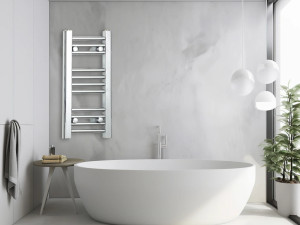
How to Estimate Bathroom Heat Loss
Bathroom heat loss is the rate at which warmth escapes on a cold day. Estimate it in watts so you can compare it with the heat the towel rail delivers at your system’s design temperatures.Start with measurementsMeasure the internal length, width and ceiling height. Record window and door sizes, which walls face outside, and what is above and below ..
11 Nov
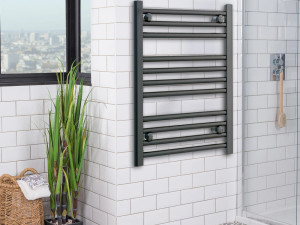
BTU/h to Watts: Compare Towel Radiator Ratings
Divide BTU/h by 3.412 to get watts. Multiply watts by 3.412 to get BTU/h. The conversion changes the units. For a fair comparison, both ratings also need to use the same temperature conditions.Worked examples1,000 BTU/h is about 293 W. A 500 W rating is about 1,706 BTU/h. A room requiring 650 W needs about 2,218 BTU/h at the design conditions. Keep..
11 Nov
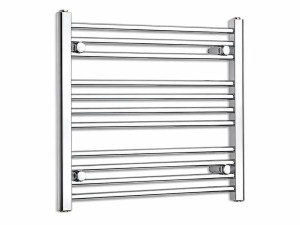
Radiator ΔT50 vs ΔT30: Compare Real Heat Output
Radiator ΔT is the difference between the average water temperature and the room temperature. The same rail usually delivers less heat at ΔT30 than at ΔT50.Work out the temperature differenceAdd flow and return temperatures, divide by two, then subtract the design room temperature. Flow at 75 °C, return at 65 °C and a room at 20 °C gives ΔT50. Flow..
11 Nov
Choosing a Towel Radiator for a Heat Pump
A water-fed towel radiator can work with a heat pump if it delivers enough heat at the planned flow and return temperatures. Ask for those temperatures and the bathroom’s design heat loss before choosing the rail.Start with the installer’s design figuresAsk for the bathroom heat loss in watts, the design room temperature and the expected flow and r..
11 Nov
Why Same-Size Towel Radiators Can Give Different Heat Outputs
Two towel radiators with the same width and height can deliver different amounts of heat. Compare the exact models in the same units and at the same ΔT, then consider how you will hang towels.Look beyond the overall dimensionsTube number, diameter, spacing, depth and the shape of the rail affect its effective surface area. Finish and construction m..
Showing 1 to 5 of 5 (1 Pages)