
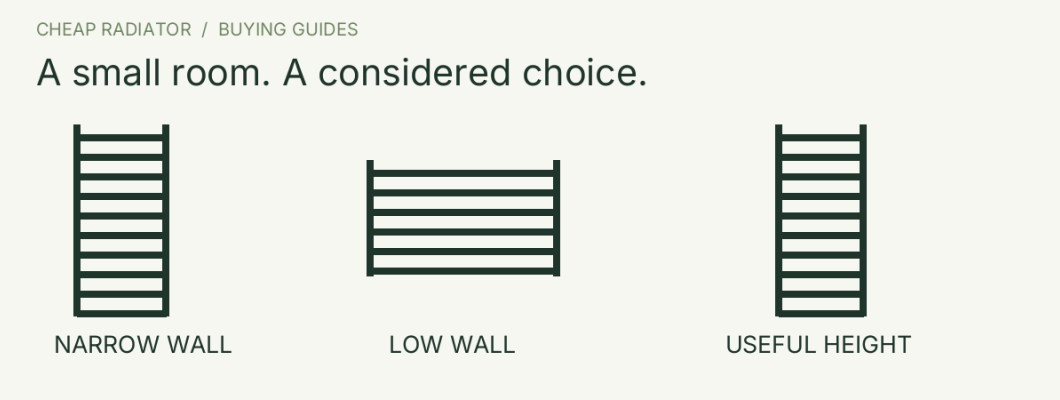
Quick answer: Choose a towel radiator that fits the wall and meets the room’s heating requirement. Measure usable width, height, projection and connection centres before comparing models. A narrow rail saves wall width, but a compact bathroom does not automatically need a low-output radiator.
Start with the room, not a radiator size
A small bathroom asks one piece of equipment to do several jobs: warm the room, hold towels and leave enough space to move comfortably. The narrowest model is not always the best choice. A rail that fits neatly beside a basin can still disappoint if its output is too low, its valves obstruct a cupboard or its towels catch the door.
Work through the checks below before selecting a finish. You will end up with a shortlist based on your bathroom’s actual layout rather than a generic recommendation for “small rooms”.
1. Decide what the towel radiator needs to do
Will it be the room’s only heat source, or mainly a towel warmer alongside underfloor heating or another radiator? That distinction changes the decision. A secondary towel rail can be selected around towel storage and the remaining heat requirement. The only radiator in the bathroom must be sized against the room’s full design heat loss.
Also think about normal use: how many towels you hang, whether they are folded over the bars and whether heating is required when the main central heating is off. Avoid judging towel capacity from the radiator’s height alone; look at the gaps between its sections and the dimensions of the towels you actually use.
2. Measure the space you can genuinely use
Measure between finished surfaces, including tiles and skirting. Mark the proposed outline with low-tack tape, then open the bathroom door, shower screen, drawers and cupboards. Allow for the radiator’s projection, the selected valves and towels hanging on the front. An empty wall gap is not necessarily a usable installation space.
| Space available | A useful starting point | Check before choosing |
|---|---|---|
| A narrow strip of wall | A slim rail using available height | Listed heat output, valve access and towel width |
| A low wall beneath a window | A shorter, wider rail | Window sill clearance and usable hanging space |
| A wall beside a basin or doorway | A rail with suitable installed projection | Door swing, comfortable movement and reach |
| Existing pipework you want to retain | A rail with compatible connections | Connection centres, pipe position and valve dimensions |
Our towel radiator measuring and size guide explains width, height and projection in more detail. Browse small and narrow towel radiators if wall width is limited, or consider the wider towel radiator range when a low wall offers more horizontal space.
3. Check heat output before choosing a height
Floor area alone cannot tell you which radiator will heat a bathroom. Insulation, external walls, glazing, ventilation and the desired indoor temperature all matter. Use the room heat-output calculator as an initial estimate; ask your installer for a room-by-room heat-loss calculation when the towel rail will be the sole heat source or the heating system is being changed.
Compare radiator outputs at the same water-temperature conditions. A figure quoted at ΔT50 cannot be compared directly with one quoted at ΔT30. Use the selected model’s output data for the proposed operating temperatures rather than assuming a universal correction factor.
For a heat pump or another low-temperature system, check the output available at the proposed operating temperatures. The Energy Saving Trust’s heat-pump guidance explains the importance of emitter size and surface area. Our guide to BTU, watts and bathroom heat output walks through the comparison.
4. Match the connection centres and valves
Radiator width and pipe centres are different measurements. The first describes the body; the second describes the spacing between the relevant connection centre-lines. Confirm both against the product details and the installer’s pipework plan.
In our towel radiator range, the listed connection centres are 50mm less than the body width: for example, a 200mm-wide rail has 150mm centres and a 550mm-wide rail has 500mm centres. Treat this as a range-specific measurement, not a rule for all radiators. Valve dimensions can also affect where finished pipework needs to sit. See how to measure towel radiator pipe centres before ordering a replacement.
Choose straight or angled valves according to the route between the pipe and radiator connection. Finish comes after that practical choice. Our straight versus angled valve guide shows what to confirm with your installer.
5. Choose the finish as part of the whole room
Chrome can repeat the finish of taps and shower fittings; matt black can tie in with black handles, screens or accessories. In a compact bathroom, look at the radiator from the doorway as well as close up. Consider the wall colour, lighting and the towels that will usually cover part of it.
Do not assume that every black radiator is hotter, more efficient or lower-maintenance than every chrome model. Compare the particular products, their output ratings and their care instructions. The chrome versus black towel radiator guide separates appearance from heating performance.
6. Confirm the heating system and what is included
A central-heating rail is not automatically ready for electric-only or dual-fuel operation. An element must be suitable for the radiator and installation. Ask for compatibility confirmation before buying an element or kit; do not assume that a matching thread or a higher wattage proves suitability.
For electrical bathroom work, Electrical Safety First recommends using a registered electrician. They should confirm positioning and protection for the actual installation. A general buying guide cannot approve a bathroom electrical layout.
Cheap Radiator towel radiators are supplied with wall brackets, an air vent and a blanking plug. Check the selected product and valve option so you know whether valves or an element are part of your order. Our stated warranty is five years for towel radiators and one year for accessories, subject to the applicable terms.
A practical buying checklist
- Measured body width, height and installed projection against the finished room.
- Checked doors, drawers, towels and valve access.
- Confirmed the required output and the radiator’s rating conditions.
- Checked connection centres, pipe diameter and valve shape.
- Confirmed compatibility with the intended heating system.
- Reviewed the supplied fittings, selected options and delivery costs and times.
Small-bathroom questions
Practical answers to help with the choices covered in this guide.
Is a taller radiator always better in a small bathroom?
Only if the extra height fits the layout and the selected model provides the output and hanging space you need. Compare its actual specification rather than height alone.
Can a towel radiator be the only heater?
Yes, when its usable output at your system’s operating conditions meets the room’s calculated requirement. If it does not, consider a different model or an additional heat source with your installer.
What should I send if I need help choosing?
Send the usable wall dimensions, the desired heating role, existing connection measurements and clear photographs of the pipework. Contact Cheap Radiator for help narrowing the options before buying if any measurement is uncertain.
Plan how you will use and look after the rail
Compare central-heating, electric and dual-fuel arrangements if you want towel warming outside normal heating periods. Once installed, follow our towel radiator cleaning and care guide alongside the product instructions.