
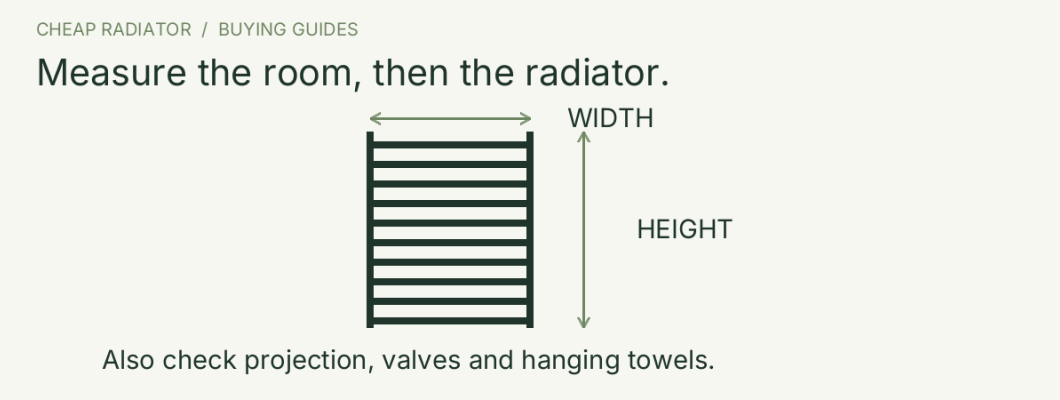
Quick answer: Measure the usable wall width and height, then check the installed projection, valves and hanging towels. Product dimensions usually describe the radiator body; they do not prove that the complete installation will fit. Check heat output separately.
Part of our small-bathroom towel radiator buying guide. This article focuses on measuring the space available.
Which dimensions do you need?
Write down the radiator’s width and height in millimetres, following the labels on the product page. Retailers do not always write dimensions in the same order. “200mm wide × 800mm high” describes a narrow upright rail; reversing those numbers describes a very different shape.
| Measurement | What it describes | Why it matters |
|---|---|---|
| Body width | The radiator body from side to side | Whether it fits the available wall and towel arrangement |
| Body height | The radiator body from top to bottom | Reach, wall space and the positions of nearby fittings |
| Installed projection | How far the fitted radiator extends from the wall | Movement past it and clearance to doors or furniture |
| Connection centres | Spacing between connection centre-lines | Matching the planned pipework and valves |
Measure against the finished room
- Measure from the finished tiled or plastered surfaces, not unfinished studwork.
- Note obstructions such as the sill, skirting, socket covers, basin and shower screen.
- Mark the proposed body outline with low-tack tape.
- Check doors, drawers and cupboards through their full normal movement.
- Allow for the actual bracket projection, valves and towels, using the selected model’s installation information.
A strip of cardboard held at the proposed projection can help you judge an awkward walkway. It is a planning aid, not a substitute for the manufacturer’s drawing. Fixing positions and required clearances are model-specific. Use the instructions supplied for the radiator you buy.
When does a narrow rail make sense?
A narrow rail is a useful starting point beside a vanity or on a restricted wall. Our 200mm-wide chrome towel radiators and 200mm-wide black towel radiators let you compare slim options. The chosen height must still fit and its output must meet the heating requirement.
For example, a 260mm wall gap does not automatically approve a 200mm radiator. You still need to account for the installation drawing, valve position and access. Nor does choosing a taller version guarantee a particular heat output: check the listed rating for that exact model.
Could a wider, shorter radiator work better?
A low wall beneath a window may offer more useful width than height. A shorter rail can also make its upper bars easier to reach. Compare a few shapes within the wide towel radiator collection rather than assuming a small bathroom always needs the narrowest rail.
Judge towel hanging in practice. Large bath towels may need folding on a slim rail, and a thick stack can make the radiator more cumbersome beside a doorway. Leave access to the air vent and valve controls rather than enclosing the radiator tightly with furniture.
Measure existing pipework separately
If you hope to retain the pipework, record its centre-to-centre spacing, pipe diameter and the direction in which it approaches the radiator. A matching body width alone is not enough. Our pipe-centre measuring guide explains the distinction and gives examples from the Cheap Radiator range.
Finish the shortlist with a heat-output check
Do not use a table saying that one width “heats every small bathroom”. Room heat loss and the radiator’s operating temperature are separate from whether it fits the wall. Once you have two or three physical options, compare them using the BTU and watts guide.
Bathroom electrical positioning
If the planned rail uses an electric element, check its position before fixing the final layout. Electrical Safety First’s bathroom advice explains why bathroom electrical work needs particular care. Ask a registered electrician to confirm the proposed installation.
Before you order
Keep a note of the finished wall space, proposed model dimensions, bracket projection and connection details. If a dimension is missing, ask for it before arranging pipework. The small and narrow radiator range is a starting point for comparison, not a guarantee that every model suits every compact room.
Compare real dimensions
For two different wall layouts, compare the 200mm-wide, 800mm-high black rail with the 550mm-wide, 400mm-high chrome rail. These are measurement examples, not recommendations for a fixed room size. Check each page’s current options and output.
Choosing a particularly narrow rail?
For restricted wall width, use our narrow towel radiator buying guide to compare 200mm to 350mm widths in chrome and black, usable height, replacement fit and heat output.
Questions about measuring your bathroom
Practical answers to help with the choices covered in this guide.
Is the wall gap the same as the radiator width I should order?
No. The body must fit alongside the selected valves, bracket projection and hanging towels. Check doors, drawers and access against the exact installation drawing rather than ordering a body that just fills the gap.
Should I measure before or after the bathroom is tiled?
Use the finished surface positions. Tiles, plaster and boxing can reduce usable space or change the wall-to-connection measurement. If work is unfinished, have the installer confirm the final dimensions before ordering.
Does a product photograph show the radiator at its real size?
Not reliably. Different sizes can be displayed at similar scale online. Use the labelled width and height in millimetres and mark a full-size outline on the wall.