
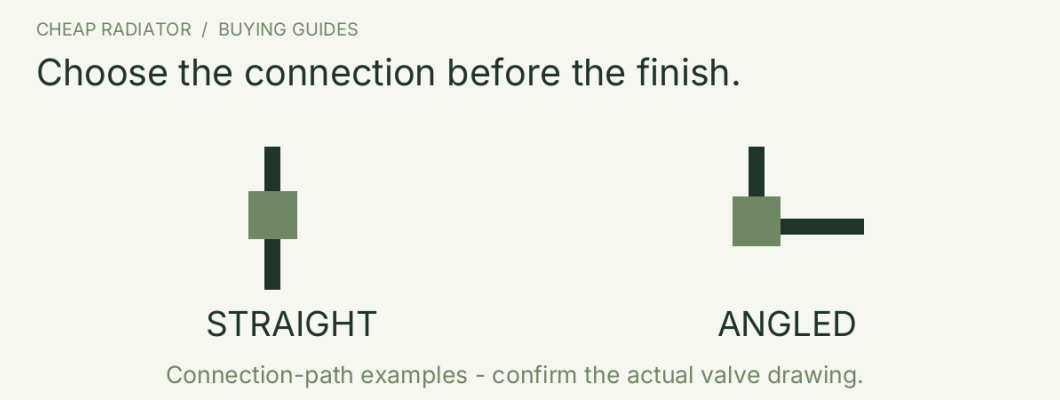
Quick answer: Straight valves keep the main connection path in line; angled valves turn it through roughly 90 degrees. Choose by the relationship between the pipe and the radiator connection, not by finish alone. Confirm pipe diameter and system controls separately.
Part of our small-bathroom towel radiator buying guide. This article focuses on choosing the connection shape and controls.
Start with the connection direction
Look at how the pipe approaches the radiator inlet. If those connections line up, a straight valve may be appropriate. If the route needs to turn, an angled valve may be appropriate. The actual inlet orientation, valve dimensions and surrounding space determine the final choice.
| Typical arrangement | Option to investigate | Confirm first |
|---|---|---|
| Pipe rises towards a downward-facing inlet on the same axis | Straight valve | Alignment, heights and fitting dimensions |
| Pipe approaches from the wall towards a downward-facing inlet | Angled valve | Direction of the turn and wall projection |
| Existing pipework, a side inlet or an unusual layout | Installer-led selection | The complete connection drawing and required access |
These are planning examples, not installation approval. “Pipes from the floor” or “pipes from the wall” is not enough information on its own. A photograph that shows both the pipe route and the radiator connection is much more useful.
Check the manufacturer’s connection drawing
Use the drawing and dimensions for the valve you actually intend to buy. Confirm the radiator-side connection, pipe-size option and space needed for the valve body before ordering.
The pipe-centre measuring guide explains why a matching radiator width does not settle valve compatibility. The valve body can affect the finished connection position and the room needed around the radiator.
Manual valve, thermostatic valve and lockshield are different roles
- Manual control: the user adjusts the opening by hand; it does not automatically sense room temperature.
- Thermostatic radiator valve (TRV): responds to the surrounding temperature to regulate flow, subject to correct selection and positioning.
- Lockshield: normally used for balancing the circuit rather than day-to-day temperature adjustment.
A valve’s straight or angled shape is separate from how it controls the heating. Ask your installer what controls the system needs, especially where a room thermostat, a heat pump or minimum-flow requirements are involved. Do not assume that any pair of valves provides automatic temperature control.
Energy Saving Trust’s heating-controls guide explains how TRVs regulate hot-water flow in response to room temperature. That control function is separate from whether the valve body is straight or angled.
Choose the correct pipe-size option
Check whether the pipework is 8mm, 10mm, 15mm or another size. The radiator-side thread and the pipe-side diameter are different specifications. A set that looks right in a photograph may still need a different connection or reduction fitting.
Read the selected option and the package contents in our radiator valve range. Do not assume reducers are included with every valve set. Where an option states that reduction fittings are supplied, check that they match the measured pipe size.
Leave access in a small bathroom
A valve that fits physically may still be awkward beside a vanity or behind an opening door. Leave room to operate the control, inspect the connection and carry out maintenance. Consider the valve with towels hanging on the rail, not just the bare radiator.
Pick the geometry first and then match the finish. Our chrome and black finish guide helps with the visual choice. For a radiator add-on, check the product page’s selected total so you can see exactly which valve option is in the basket.
What if I want dual-fuel heating?
A heating element and any connection kit need separate compatibility checks. A valve pair does not make a central-heating towel radiator suitable for electric or dual-fuel use. Confirm the radiator, element, kit and intended controls together before ordering.
Electrical Safety First advises using a registered electrician for bathroom electrical installation work. The installer should determine the safe arrangement for the actual products and room; this guide is about choosing components, not wiring or commissioning them.
Before adding the valves to your order
- Confirm the radiator inlet orientation and pipe route.
- Check the required straight or angled connection and the fitting dimensions.
- Confirm pipe diameter, thread compatibility and any reducers.
- Check which controls and balancing arrangement the system needs.
- Read the selected option and included components before checkout.
Questions about choosing radiator valves
Practical answers to help with the choices covered in this guide.
Does angled mean thermostatic?
No. Straight or angled describes the connection path. Manual or thermostatic describes the control function. Confirm both the geometry and the control arrangement your system needs.
Can I choose a valve just from where the pipes come out?
Pipe direction is useful, but the radiator connection orientation and exact valve drawing must also be checked. Confirm the assembled dimensions and access with the installer.
Are pipe reducers included with every valve pair?
Do not assume so. Read the selected pipe-size option and package contents. Any supplied reduction fittings must match the measured pipework.
For the full fitting checklist, see the towel radiator valves and fittings guide. Browse radiator valves once you have confirmed the measurements and fittings for your installation.
For the full checklist, see our guide to replacing a bathroom radiator with a heated towel rail.