
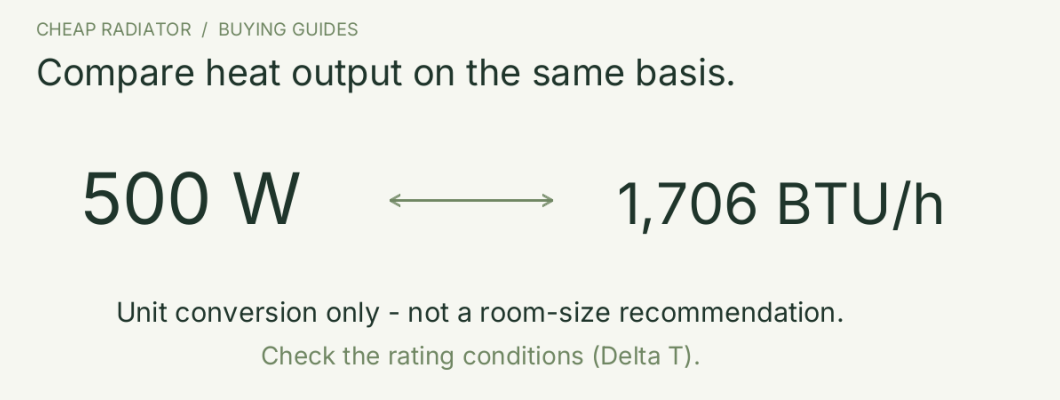
Quick answer: Choose output to match the room’s heat loss, not just its floor area or the radiator’s physical size. BTU/h and watts measure heat output: 1 watt is about 3.412 BTU/h. Compare ratings at the same temperature difference, written as ΔT.
Part of our small-bathroom towel radiator buying guide. This article focuses on checking the heat output your room needs.
What does a BTU rating tell you?
A radiator’s BTU/h rating is a rate of heat output. A BTU is a quantity of heat; BTU per hour describes how quickly heat is delivered. Product listings often shorten “BTU/h” to “BTU”, so check what the figure means rather than treating it as an electricity consumption figure.
Watts are another unit for the same output. The conversion follows the NIST Guide for the Use of SI units. To convert watts to BTU/h, multiply by approximately 3.412. To convert BTU/h to watts, divide by the same number.
| Output in watts | Approximate output in BTU/h |
|---|---|
| 300 W | 1,024 BTU/h |
| 500 W | 1,706 BTU/h |
| 750 W | 2,559 BTU/h |
| 1,000 W | 3,412 BTU/h |
This is a unit-conversion table, not a radiator recommendation for a particular bathroom size. A 500 W electric element is also not automatically suitable for a rail with a 500 W central-heating rating.
Why a small bathroom can need substantial heat
Two rooms with the same floor area can lose different amounts of heat. External walls, glazing, roof and floor exposure, insulation, air leakage, ventilation and the target room temperature affect the calculation. A compact corner bathroom in an older home may therefore need a different radiator from a similarly sized internal en-suite.
Use the heat-output calculator for a starting estimate. If the radiator will be the only heat source, have an installer check the room’s design heat loss. Do not reduce necessary ventilation to make an undersized radiator seem adequate.
What is ΔT?
For radiator rating comparisons, ΔT describes the difference between the mean water temperature and the room air temperature. A simple example is:
ΔT = (flow temperature + return temperature) ÷ 2 − room temperature.
- 75°C flow, 65°C return and a 20°C room give ΔT50.
- 55°C flow, 45°C return and a 20°C room give ΔT30.
The lower temperature difference reduces the same radiator’s output. Ask for the selected model’s output at your proposed operating temperatures or its approved correction data. Do not apply a correction factor from an unrelated radiator.
How to compare two towel radiators
- Find the room’s required output in watts or BTU/h.
- Confirm the intended heating system’s flow, return and room temperatures.
- Check the test or rating conditions attached to each radiator’s published figure.
- Compare output at the relevant conditions, alongside the dimensions that fit your bathroom.
If a listing does not state the rating conditions, ask before relying on it for a sole heat source or low-temperature installation. Do not silently assume every advertised figure is ΔT50.
What changes with a heat pump?
Heat pumps commonly use lower radiator water temperatures than traditional high-temperature designs. The Energy Saving Trust explains that greater emitter surface area can support lower water temperatures. A towel rail needs to be assessed for the actual system, rather than accepted or rejected simply because of its finish or width.
Ask the installer whether the chosen rail can provide the required room output, whether another emitter is needed and whether the manufacturer confirms system compatibility. Our narrow towel radiators and wider models should be compared by their individual data.
Can towels affect the result?
How the rail is used matters alongside the published rating. Towels covering the bars change how heat reaches the room. If both towel storage and sole-room heating are important, discuss the normal towel arrangement when the installer checks the output rather than choosing a rail at the limit of a rough calculator estimate.
Does a bigger BTU number mean lower bills?
No. Output describes heating capacity under stated conditions. Running cost depends on the heat source, controls, temperature settings, operating hours and building heat loss. A larger catalogue number alone does not establish better efficiency or cheaper operation.
Questions about BTU and heat output
Practical answers to help with the choices covered in this guide.
Is a radiator’s BTU figure its electricity consumption?
No. The listing usually means BTU per hour, a rate of heat output. Electrical energy consumption is measured in kilowatt-hours; a water-heated radiator’s output rating is not an electricity bill estimate.
Can I compare a ΔT50 output directly with a ΔT30 output?
Not as a like-for-like comparison. Ask for the exact models’ outputs at the same intended operating conditions or their approved correction data.
Can the room calculator replace a heat-loss calculation?
Use it as a starting estimate. Have the final requirement checked for the actual room and system, particularly when the towel radiator will be the only heat source or the system uses lower water temperatures.
Choose a towel rail for your bathroom’s heat requirement
Start with the bathroom BTU calculator, then compare that estimate with the rail’s heat output at your planned water temperatures. Use the guides below for each step.
- How to Estimate Bathroom Heat Loss
- BTU/h to Watts: Compare Towel Radiator Ratings
- Radiator ΔT50 vs ΔT30: Compare Real Heat Output
- Can a towel rail heat your bathroom on its own?
- Choosing a Towel Radiator for a Heat Pump
- Why Same-Size Towel Radiators Can Give Different Heat Outputs
Compare the old radiator with its replacement
Use the old radiator’s model and technical sheet if you can identify them. Compare both emitters in watts at the same temperature conditions, then check the new rail against the room’s design heat loss. If the old model is unknown, use a room heat loss calculation to size the replacement.
For the full checklist, see our guide to replacing a bathroom radiator with a heated towel rail.