
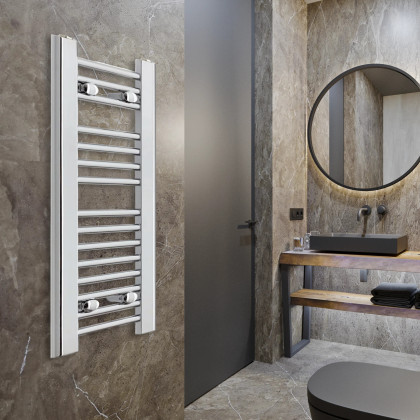
200mm Wide 800mm High Flat Chrome Towel Radiator
- Size
- 200 × 800mm (W × H)
- Pipe centres
- 150mm
- Finish
- Chrome
- Listed output
- 643 BTU/h · 188 W
Available to order
£54.99Inc. VATRadiator only · valves extra
View sizes & options
Quick answer: A narrow towel radiator can heat a bathroom if the exact model’s output at the intended system temperatures meets the room’s heat loss. Body width alone cannot answer this. Check the chosen height and finish, whether other heating is present, and how the rail will be used with towels.
A slim rail may be intended to warm towels while another emitter heats the bathroom. In another home, it may be expected to do both jobs on its own. Establish that role before buying. A rail that suits occasional towel warming is not automatically a complete room-heating solution.
This article supports our narrow towel radiator buying guide. For general unit conversions and rating explanations, use the existing BTU, watts and ΔT guide; here the focus is on making a decision when wall width is restricted.
Room heat loss depends on more than floor area. External walls, glazing, insulation, ventilation and the intended indoor temperature all matter. A compact bathroom with exposed walls can behave differently from an internal room of similar size.
Use the on-page calculator as a starting estimate and ask an installer to confirm the requirement for the final selection. Tell them whether underfloor heating or another radiator contributes to the room. Avoid counting the same heating contribution twice.
Keep width, height, finish and output together on your shortlist. Do not attach one output figure to an entire width range. A 200mm rail in one height is a different choice from a taller model, and black and chrome figures should be checked individually.
Browse 200mm chrome towel radiators and 200mm black towel radiators if width is especially tight. If the room allows more space, compare 350mm chrome towel radiators and 350mm black towel radiators. These are size options to investigate, not recommendations for a fixed room area.
Additional height may provide a higher-output option within the same width, but check the published rating rather than estimating from the outline. The model must also fit below obstructions, suit the wall and remain convenient to use.
Our height and reach guide helps you assess the practical limit. If the tallest suitable model still does not meet the requirement, discuss another emitter or a different arrangement. Buying an awkwardly tall rail is not a reliable answer to an output shortfall.
CIBSE Journal’s radiator-sizing discussion explains that flow, return and room temperatures influence output. A catalogue figure at one set of conditions cannot simply be assumed to apply at another. Ask for the exact model’s performance at your intended operating temperatures.
This is particularly relevant to heat pumps. Energy Saving Trust notes that radiator upgrades can be needed when installing a heat pump. A narrow rail is not automatically unsuitable, but its available output must be checked within the overall design rather than accepted from the headline rating alone.
Towels change the way heat reaches the room. Do not assume that a heavily covered rail will give the same room-heating effect as an uncovered rating arrangement. Consider how often it will be covered and whether another heat emitter provides background warmth.
There is no useful universal promise that a particular narrow width will dry a fixed number of towels in a fixed time. Towel material, folding, moisture, the rail layout and operating conditions all affect use. Make your purchase decision from the confirmed product and room information.
A central-heating towel rail normally depends on its heating circuit running. If you want towel warming independently of the main heating, ask about a compatible electric or dual-fuel arrangement for the exact rail. Do not choose an element simply by matching its wattage to a water-heating output figure.
Use the 200mm versus 250mm comparison or 300mm versus 350mm comparison to turn those checks into a manageable shortlist. The aim is a rail that fits and performs, rather than the narrowest model available.
Practical answers to help with the choices covered in this guide.
Only when the exact model’s usable output at the intended temperatures meets the room’s heat loss. Width alone cannot answer this; check height, finish and normal towel use as part of the selection.
No. Insulation, glazing, exposed surfaces, ventilation and target temperature affect heat loss as well as room size. Use an estimate as a starting point and have the final requirement checked.
Tell the installer if another emitter contributes heat. They should assess the room’s combined heating arrangement and avoid counting the same contribution twice.
Sources support the general heating and safety points linked above. Dimensions, supplied fittings and range examples refer to Cheap Radiator’s listings. Check the selected product and ask your installer to confirm suitability.
Compare the room’s design heat loss with the exact rail’s output at your planned water temperatures. If the rail falls short, consider a higher-output model or a separate room heat source. If it meets the calculated demand, still discuss normal towel coverage and installation with your heating engineer. See our bathroom heating and BTU guide for the full sizing process and use the bathroom BTU calculator for a starting estimate.
Explore chrome and black examples relevant to this guide, then check the exact size and listed heat output on the product page.
Available to order
£54.99Inc. VATRadiator only · valves extra
View sizes & options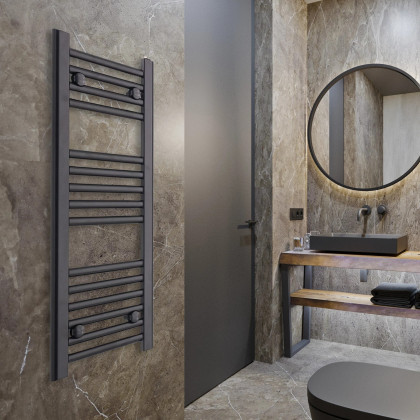
Available to order
£64.99Inc. VATRadiator only · valves extra
View sizes & options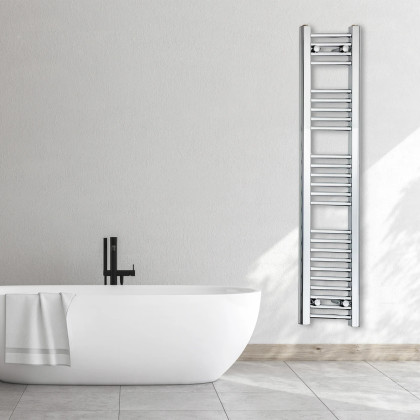
Currently unavailable
£68.99Inc. VATRadiator only · valves extra
View product details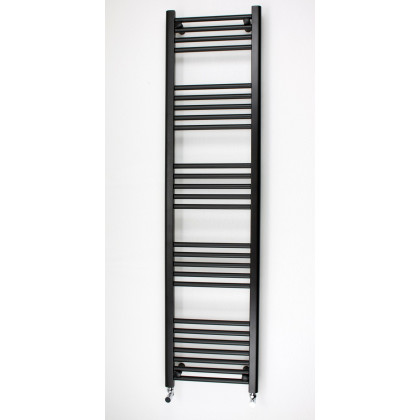
Currently unavailable
£74.99Inc. VATRadiator only · valves extra
View product detailsPrices and availability come from the current catalogue. Examples may differ in height and output. Check the exact model’s full specification, rating conditions and installation suitability before choosing.