
Quick answer: Choose width around usable wall space and towel storage, then check the exact radiator’s heat output. Neither wide nor narrow is automatically more efficient.
Choose the shape around the usable space
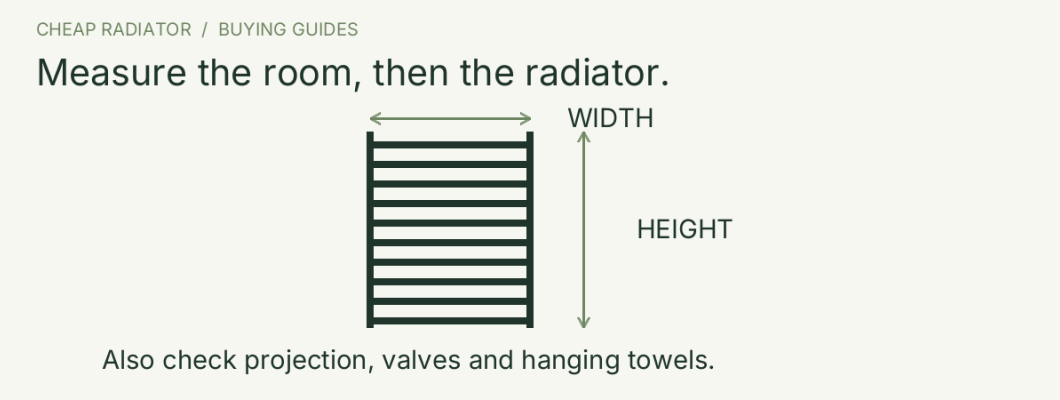
A narrow upright rail can use a strip of wall beside a basin. A shorter, wider model may work beneath a window or on a low wall. Start with measuring width, height and projection; include door movement, valve access and towels in the proposed outline.
There is no single recommended width for all small, medium or large bathrooms. Room layout and heat loss vary independently. A model that fits the wall can still have insufficient output for the room.
Compare the practical trade-offs
| Question | Narrow rail | Wider rail |
|---|---|---|
| Wall shape | Can use limited horizontal space | Can make use of a broad or low wall |
| Towel arrangement | Large towels may need folding | May allow towels to spread further across the bars |
| Heat output | Check the exact height, design and rating | Check the exact height, design and rating |
| Installation | Check connection centres and access | Check connection centres and access |
Does a wider radiator give more heat?
Additional surface area can increase output within a comparable design, but width alone is not enough to rank different radiators. Height, tube arrangement, finish and water-temperature conditions matter. Compare the published figures for the actual products using our guide to BTU, watts and rating conditions.
A larger catalogue output is heating capacity, not evidence of lower running cost. Avoid choosing a rail from a generic width-to-room-size table.
Think about your normal towels
Compare the useful bar spacing with the towels you use. Consider how many towels will hang at once and how far they project when folded. A wide rail can provide useful hanging space, but it does not guarantee a particular drying time or remove the need for ventilation.
Check the replacement pipework
Body width and connection centres are separate dimensions. In this towel rail range, listed connection centres are 50mm less than body width. Valve geometry still needs checking: see the pipe-centre measuring guide before assuming existing pipework will line up.
Make a shortlist
Compare our small and narrow towel radiators with our wide towel radiators. Select models that fit, compare their output at the intended temperatures, then choose the finish and valves.
For independent advice about managing heating temperatures and schedules, see Energy Saving Trust’s heating-controls guide. Suitable controls and room heat loss matter alongside radiator dimensions.
Planning a wider rail?
Once you have chosen a wider layout, use our wide towel radiator buying guide to compare widths, replacement fit, heat output, finishes and valves.
Questions about wide and narrow layouts
Practical answers to help with the choices covered in this guide.
Is a short, wide rail better than a tall, narrow one?
It depends on the available wall, convenient hanging gaps and required output. Compare the complete fitted dimensions and exact model ratings rather than the shape alone.
Will a wider towel radiator dry towels faster?
Width alone cannot establish drying time. Towel material, folding, moisture, the rail layout and operating conditions all affect the result. Compare usable hanging space without assuming a fixed drying promise.
Can I change from narrow to wide without moving the pipes?
Do not assume so. Check the connection centres, valve geometry and wall projection with your installer. The change in body width is not the only installation difference.