
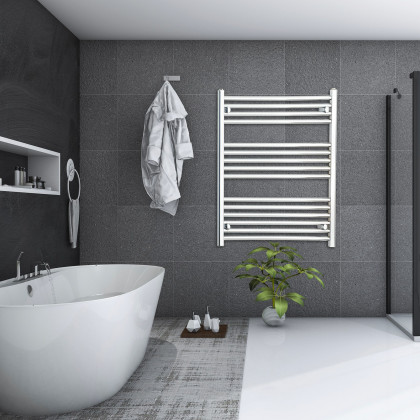
550mm Wide 800mm High Polished Chrome Flat Towel Radiator
- Size
- 550 × 800mm (W × H)
- Pipe centres
- 500mm
- Finish
- Chrome
- Listed output
- 1,558 BTU/h
Available to order
£76.99Inc. VATRadiator only · valves extra
View sizes & options
Quick answer: Choose a wide towel radiator by checking usable wall space, connection centres and the room’s heat requirement together. Width alone does not establish heating performance. Compare the exact height, finish, listed output and valve arrangement before ordering.
There is no single width that makes every towel rail a wide model. Here, the useful starting point is a rail that uses more horizontal wall space, rather than relying mainly on height. Our wide towel radiators collection lets you compare widths and finishes without treating one measurement as a complete specification.
A wider rail can suit a wall below a shelf, a broad space beside a vanity unit or a bathroom where tall furniture limits height. It can also offer a different way to arrange towels. It does not follow that the widest rail is the warmest, the easiest to fit or the best choice for every family bathroom.
Record the usable wall width and height, allowing for doors, drawers, skirting, shelves and the route you take through the bathroom. Check radiator projection as well as body size. A towel hanging over a rail occupies space beyond the metalwork, and a valve can need room beside or below the body.
Use our 550mm to 800mm width comparison to make a shortlist. Then compare the product drawing or specification with the actual wall. A nominal width is not an installation tolerance: a 600mm space should not automatically be treated as suitable for a 600mm radiator.
Pipe centres are the distance between connection centre lines, not the overall body width. In our towel radiator ranges, the listed centres are 50mm less than the body width: a 650mm-wide rail has 600mm centres. This is a range-specific rule, not a promise about every radiator sold elsewhere.
Existing pipes may still need changes because valve dimensions, wall projection and connection positions affect the assembled fit. Our replacement and pipe-centre checklist explains what to record before ordering.
Start with a room heat-loss estimate, then ask your installer to confirm the required output and the heating system’s operating conditions. Compare watts or BTU/h for the exact model at the same rating conditions. Do not use width, price or finish as a substitute for an output figure.
Lower-temperature systems need particular care. Energy Saving Trust’s air source heat pump advice explains that radiator changes can be necessary when adapting a home to a heat pump. Our wide-radiator heat-output guide takes you through the buying checks without assuming that a larger body solves every heating problem.
Black can provide a strong outline on a pale wall; chrome can coordinate with taps and shower fittings. These are design choices. Check the actual finish and output of each model rather than assuming that all black and chrome versions are interchangeable.
For a starting shortlist, compare 550mm-wide black towel radiators, 650mm-wide black towel radiators and 800mm-wide black towel radiators within the wider collection. Our black-or-chrome guide for a wide rail focuses on visual scale, matching accessories and care.
Radiator-only purchases do not include valves. Our towel radiators come with wall brackets, an air vent and a blanking plug; the wall itself still needs suitable fixings and an installation check. Straight and angled valve choices depend on the pipe route and the radiator connections, not on width alone.
Use the valve and clearance guide before selecting accessories. If considering an electric element or dual-fuel arrangement, confirm that the exact rail and element are compatible. Electrical Safety First recommends using a registered electrician for bathroom electrical installation work.
Keep these figures together when comparing products. You can then choose on the basis of fit and comfort, rather than buying the largest rail that appears to fit a photograph.
Practical answers to help with the choices covered in this guide.
Keep width, height, projection, connection centres, valve dimensions and model output together. Then check towel use, wall support and the finish. The largest body that fits a photograph is not automatically the right choice.
Radiator-only purchases exclude valves. Our towel radiators include wall brackets, an air vent and a blanking plug. Check the selected product options and basket contents for any valve add-on.
No. Ask for the exact model’s output at the proposed system temperatures and compare it with room heat loss. Physical width does not establish heating-system suitability.
External sources support the general heating or safety points identified above. Product dimensions, supplied fittings and range examples refer to Cheap Radiator’s listings; confirm the selected product before ordering. This is buying guidance, not an installation specification.
Fitting out a shared bathroom? See our guide to choosing a wide heated towel rail for a large family bathroom for towel capacity, positioning and under-window sizes.
Explore chrome and black examples relevant to this guide, then check the exact size and listed heat output on the product page.
Available to order
£76.99Inc. VATRadiator only · valves extra
View sizes & options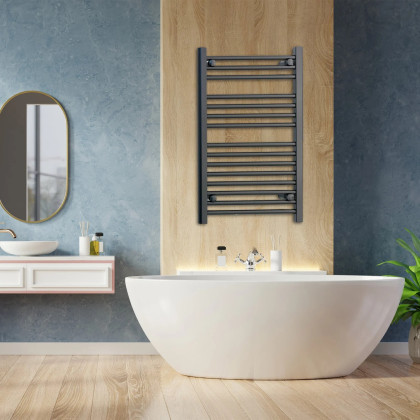
Available to order
£71.99Inc. VATRadiator only · valves extra
View sizes & options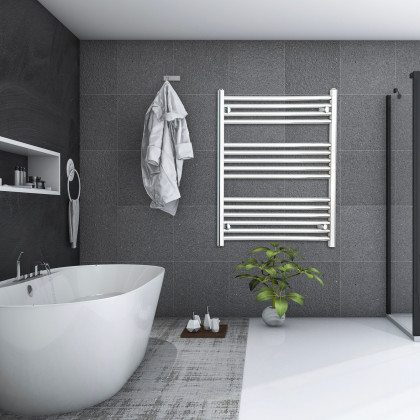
Available to order
£69.99Inc. VATRadiator only · valves extra
View sizes & options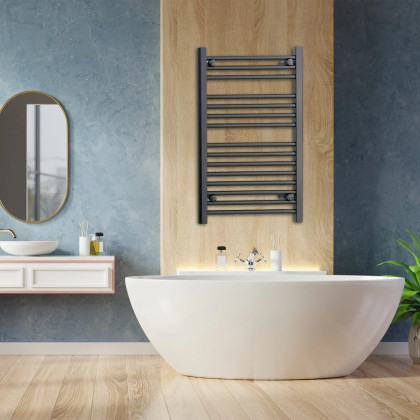
Available to order
£86.99Inc. VATRadiator only · valves extra
View sizes & optionsPrices and availability come from the current catalogue. Examples may differ in height and output. Check the exact model’s full specification, rating conditions and installation suitability before choosing.