
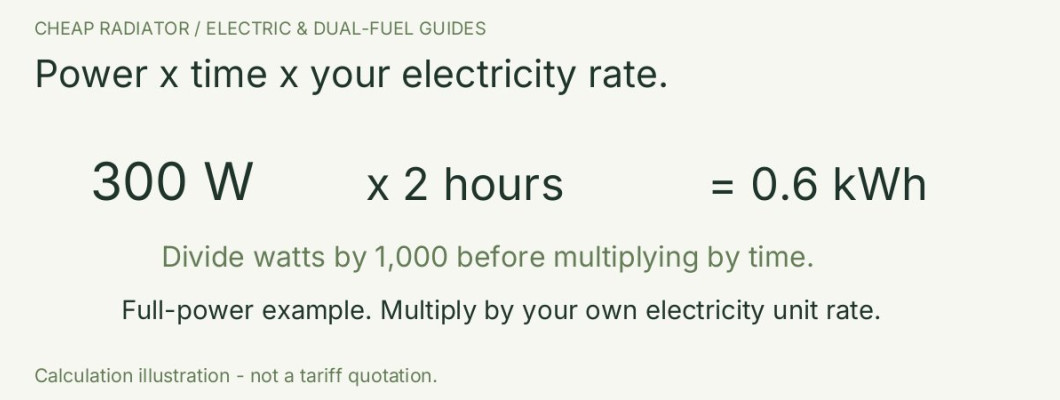
Quick answer: Electric towel rail energy use is power in kilowatts multiplied by the time the element actually draws that power. Multiply the resulting kWh by your own unit rate. A 300W element at full power for two hours uses 0.6kWh; at an illustrative 30p/kWh this costs 18p, excluding any separately payable standing charge.
Part of our electric and dual-fuel towel radiator buying guide.
Use your element’s electrical rating
Start with the wattage of the selected electrical element, not the radiator’s central-heating BTU figure. Convert watts to kilowatts by dividing by 1,000: 200W is 0.2kW, 300W is 0.3kW and 500W is 0.5kW. Check the actual option you intend to buy.
This guide supports the electric and dual-fuel towel radiator buying guide. It estimates electricity consumption; it does not choose a suitable element. Use our element sizing guide and the radiator manufacturer’s specification for that separate decision.
The calculation
Energy in kWh = element watts ÷ 1,000 × hours drawing full rated power.
Electricity cost = energy in kWh × your unit rate per kWh.
Keep the units consistent. If your rate is in pence, the result is in pence. If it is in pounds, the result is in pounds. Use the rate from your own bill or tariff information, including VAT where applicable to that figure.
Worked examples at an illustrative unit rate
| Element | Energy | Example cost |
|---|---|---|
| 200W | 0.4kWh | 12p |
| 300W | 0.6kWh | 18p |
| 500W | 1.0kWh | 30p |
| 600W | 1.2kWh | 36p |
These are calculation examples, not current electricity prices or guaranteed operating costs. For a 300W element drawing full power for two hours daily over 30 days, the same example gives 18kWh and £5.40. Change the hours, days and tariff to match your intended use.
Switched-on time is not always full-power time
A thermostat may cycle the element once its control target is reached. The wall-clock duration of a programme is therefore not necessarily the duration of full-rated electrical demand. The simple calculation is a full-power estimate for that period, not proof that a thermostatically controlled rail will consume exactly that amount.
Without measured data, the cycling percentage is uncertain. The room, starting temperature, towels, controller and chosen settings affect operation. Where you need an observed figure, discuss suitable fixed-circuit energy monitoring with an electrician; do not improvise a plug-in arrangement in a bathroom.
Standing charges and variable tariffs
The calculation covers the unit cost attributable to the electricity used. A standing charge already payable for the property is not charged again for every appliance, but it remains part of the overall bill. Installation, purchase and maintenance are separate costs.
If rates vary by time, calculate each period using the applicable rate. A weekly programme is useful only when it matches the routine and tariff you actually have. When comparing advertised daily running costs, check the stated power, time and tariff assumptions.
Compare heating arrangements fairly
Energy Saving Trust explains that secondary electric heating can be useful but can be costly to run compared with main heating systems. The useful comparison is your proposed schedule and heat source, not a universal claim that electric or dual fuel is always cheapest.
For wet heating, costs also depend on the boiler or heat pump, operating conditions and which parts of the system run. A radiator’s BTU rating cannot, on its own, tell you what it costs to switch that system on.
Controls and a manageable routine
Compare the functions in our timer and thermostat guide, then browse towel radiator heating elements. A timed session that fits your routine is easier to assess than leaving settings unexplained. Energy Saving Trust distinguishes programmers and temperature controls in its heating-controls guidance; its boiler advice should not be read as the instructions for a towel rail element.
Keep a record of the chosen element, programme and unit rate. Review the estimate when your tariff or routine changes. For occasional warm-weather use, the summer operation guide helps separate the schedule from the installation’s permitted operating mode.
Questions about running costs
Practical answers for the choices covered in this guide.
Does a 500W element always cost more to use than a 300W element?
At the same tariff and for the same time drawing full rated power, 500W uses more electricity. Over a whole session, however, run time and thermostatic cycling can differ. Do not choose an undersized or unapproved element to reduce the headline wattage; use the approved rating and compare the intended schedule.
Is the 30p per kWh figure the current electricity price?
No. It is an illustrative rate used to make the worked examples easy to follow. Replace it with your own applicable unit rate, including different time periods if your tariff varies. The examples are not quotations or guarantees of a daily bill.
Does the element use its full rated power for the entire boost period?
Not necessarily. A controller may cycle the element as its temperature target is reached. A two-hour boost describes the operating window, not proof of two hours of uninterrupted full-power demand. Use the full-power calculation as a clearly stated estimate, or obtain suitable measurements of the actual installation.
Sources and product checks
Sources and catalogue examples checked 4 November 2026. Product examples describe the listed components, not an approved pairing with every radiator. Check the selected option and current manufacturer instructions before ordering.