
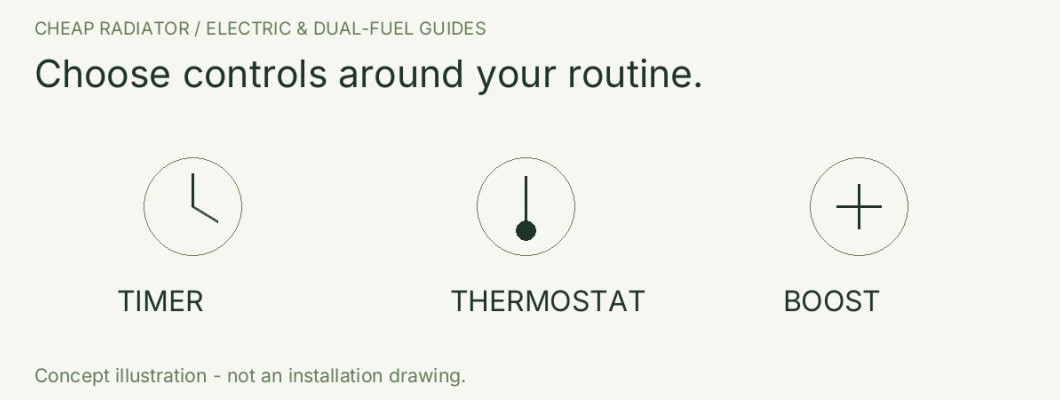
Quick answer: A timer controls when or how long heating runs; a thermostat regulates a measured temperature; a boost starts a limited heating session. Check what each element actually measures and which modes it provides. A digital display does not automatically mean a room thermostat, Wi-Fi control or a weekly programme.
Part of our electric and dual-fuel towel radiator buying guide.
Choose around the routine, not the display
Think about the moments when you want the rail to operate. An occasional shower may call for a simple timed session. A regular weekday routine may make repeat programming useful. Someone who frequently changes schedules may prefer straightforward manual controls.
This guide is part of the electric and dual-fuel towel radiator guide. Select controls only within an element and radiator combination that is approved for the intended use. Extra functions do not make an otherwise unsuitable element compatible.
What a timer does
A timer limits or schedules an operating period. A countdown runs for a chosen duration; a repeating programme can provide planned periods on selected days, if the product offers that function. These are different capabilities, even when both are described casually as a timer.
Check what happens when a programme ends and after a power interruption. Ask whether a boost temporarily overrides an existing schedule or changes a permanent setting. The manufacturer’s instructions should make the return to normal operation clear.
What a thermostat measures
A thermostat responds to a temperature measurement, but the measurement may relate to the radiator or its fluid rather than the room air. A controller setting must not be described as a guaranteed bathroom temperature unless the product actually provides the required room sensing and control.
Energy Saving Trust explains the distinct roles of programmers, thermostats and radiator valves. That source focuses on boiler controls; a towel rail element’s own instructions are needed to understand its sensor and operating modes.
What a boost is useful for
A boost gives a bounded heating session without necessarily rewriting the regular routine. Check the permitted duration, temperature behaviour and what the controller does afterwards. A longer maximum boost is not automatically a better match for every household.
For example, the current round thermostatic element with boost timer lists a 1–5 hour boost at 65°C with automatic switch-off, alongside temperature settings from 45°C to 65°C in 5°C steps. These are controller specifications, not a promised room temperature, towel-drying time or advice to select the hottest setting.
Compare actual catalogue functions
| Product | Listed functions | Package distinction |
|---|---|---|
| Round-controller element | Temperature steps and 1–5 hour boost | Dual-fuel fittings not included |
| Black digital dual-fuel kit | Weekly programme, control lock and 30-minute to 8-hour timed heating | Element, T-piece and angled valve listed |
The black digital dual-fuel kit with angled valve lists 30–70°C adjustment in Free Mode and 300W or 500W options. Confirm the available functions in the selected model’s instructions. Neither example should be assumed to offer app control or to sense room air simply because it has a digital controller.
Match the controls to the rest of the installation
An element controller and a central-heating valve act within different parts of a dual-fuel installation. One is not automatically a substitute for the other. Ask the installer to explain how each permitted operating mode is selected and which control is responsible in that mode.
Do not assume that an ordinary manual valve regulates room temperature. Equally, do not add a separate plug-in timer, extension lead or external controller without confirmation that the arrangement is suitable and permitted.
Make a clear choice before buying
Write down whether you need a countdown, a repeating programme, temperature adjustment, a control lock or a combination. Check that household members can reach and understand the controls when the rail is installed and towels are hanging.
Then compare towel radiator heating elements and use the running-cost calculation for the intended schedule. The summer use guide explains why the permitted heating mode must be checked separately from the timer settings. No control can guarantee a fixed saving or drying time for every bathroom.
Questions about towel rail controls
Practical answers for the choices covered in this guide.
Does setting the controller to 65°C mean the bathroom will reach 65°C?
No. A rail or fluid temperature setting is not a room-air temperature promise. Check what the particular controller measures. The listed 65°C boost setting on the round-controller element must not be interpreted as a target bathroom temperature.
Can I assume a digital towel rail controller has Wi-Fi?
No. A digital display can provide local settings without internet connectivity. Check for an explicit Wi-Fi or app-control specification for the exact model. The functions described in this guide do not establish smart-home compatibility.
Is a timed boost the same as a weekly programme?
No. A boost is a limited heating session; a weekly programme repeats scheduled periods when the controller supports that function. Check the instructions for what happens after a boost, whether it overrides a programme and how settings behave following a power interruption.
Sources and product checks
Sources and catalogue examples checked 4 November 2026. Product examples describe the listed components, not an approved pairing with every radiator. Check the selected option and current manufacturer instructions before ordering.