
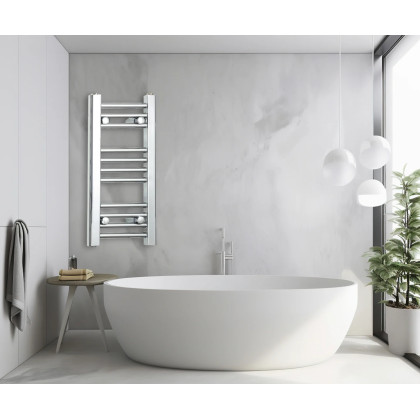
200mm Wide 600mm High Flat Chrome Towel Radiator
- Size
- 200 × 600mm (W × H)
- Pipe centres
- 150mm
- Finish
- Chrome
- Listed output
- 478 BTU/h · 140 W
Available to order
£51.99Inc. VATRadiator only · valves extra
View sizes & options
A 200mm towel radiator is worth considering where wall width is restricted beside a vanity unit, in a cloakroom or in a compact en-suite. Choose it only after checking the complete fitted footprint, access and heat requirement, because a narrow body can still conflict with doors, drawers or valve controls.
Mark the proposed rail on the finished wall with removable tape. Open the door, move the shower screen and pull out nearby drawers, then add a hanging towel to the test; the empty outline alone does not represent everyday use.
Use this guide to understand the measurements before browsing 200mm chrome sizes or 200mm black sizes. The commercial category pages carry current availability, prices and product options.
The 200mm chrome range offers several heights while retaining 150mm pipe centres, so a taller rail can use wall space that extra width cannot. The comparison below records listed BTU/h figures checked on 18 November 2026, with approximate watt conversions; use the product page to confirm current details and availability.
Swipe or scroll sideways to view the full comparison table.
| Height | Pipe centres | Listed output | Possible application | Finish choices |
|---|---|---|---|---|
| 600mm | 150mm | 478 BTU/h · about 140W | Lower wall or compact cloakroom | Chrome or matt black; check the exact model |
| 800mm | 150mm | 643 BTU/h · about 188W | En-suite wall with limited width | Chrome or matt black; check the exact model |
| 1000mm | 150mm | 925 BTU/h · about 271W | Taller wall beside a vanity | Chrome or matt black; check the exact model |
| 1200mm | 150mm | 973 BTU/h · about 285W | More vertical hanging space | Chrome or matt black; check the exact model |
| 1400mm | 150mm | 1,105 BTU/h · about 324W | Tall, narrow wall; check reach | Chrome or matt black; check the exact model |
| 1600mm | 150mm | 1,237 BTU/h · about 363W | High wall; check top-rung access | Chrome or matt black; check the exact model |
| 1800mm | 150mm | 1,402 BTU/h · about 411W | Tallest option here; check ceiling and reach | Chrome or matt black; check the exact model |
Watts above are calculated from the listed BTU/h at 1W ≈ 3.412 BTU/h, rather than a separate heat-output test. For example, 925 BTU/h converts to about 271W; the current 1000mm chrome listing also displays 274W, so confirm that model’s declared rating before specifying it.
These are catalogue comparisons, not recommended room sizes. A 600mm model is not automatically suitable for every cloakroom, and a taller version is not automatically sufficient for a bathroom. Check the selected finish, water temperatures and calculated room heat loss; do not treat a historical price or listed height as a stock guarantee.
Body width, bottom connection spacing and projection from the wall describe different parts of the installation and should be measured separately. For the checked 200mm chrome examples, the product pages list 150mm pipe centres, 75–95mm wall-to-pipe-centre distance and 90–110mm projection, subject to the exact model and bracket setting.
For a simple width example, 200mm + 30mm left fitting allowance + 30mm right fitting allowance = 260mm. With 50mm each side the total becomes 300mm; these allowances illustrate the arithmetic, not the dimensions of every valve pair. Use the selected valve drawing and the 200mm wall-space and valve-clearance guide.
Straight, angled and corner valves describe different connection arrangements, so select them from the actual pipe route rather than the radiator width alone. Some corner-valve arrangements can bring controls closer to the wall than an alternative angled arrangement, but the valve drawing and access requirements must confirm the benefit in your installation.
Pipes rising in line beneath downward-facing radiator connections often suit straight valves, while wall-fed pipework often needs a change in direction. Connection orientation varies, so ask the installer to compare the rail and valve drawings rather than using those descriptions as universal fitting instructions.
Check controller rotation, access for adjustment and the nearest obstruction with the valve open and installed. For 8mm or 10mm microbore pipework, specify a compatible reducer with the installer; pipe covers and caps are finishing parts, not substitutes for the correct connection. Browse radiator valves and compatible fittings and pipe covers.
A slim towel radiator can heat a room only when its output at the intended system temperatures meets the room’s heat loss, after allowing for how it will be used. Matt black coatings generally emit more radiant heat than polished chrome at the same surface temperature, but compare complete model ratings under the same conditions.
Radiant heat is only part of the total: convection, rail geometry, water temperature and surface area also matter. A finish is not a guarantee of lower running costs, and towels covering the bars can change heat delivery to the room. Start with the BTU calculator and ask the installer to confirm the design heat loss.
UK radiator data are often quoted at ΔT50, meaning a 50°C difference between mean water temperature and room temperature; confirm the rating basis of the model you select. Where a verified ΔT50 rating and an exponent of 1.3 apply, a ΔT30 estimate is (30 ÷ 50)1.3 ≈ 0.515, or roughly half the output. The manufacturer’s correction data take priority.
For illustration only, 478 BTU/h at a verified ΔT50 would become about 246 BTU/h, or 72W, under that ΔT30 assumption. This is not a separately verified heat-pump rating for the listed model: use the narrow-radiator room-heating guide and confirm the exact rating conditions before ordering.
A 200mm rail works well for hand towels or larger towels folded to fit, but it cannot hold a bath sheet spread flat across its width. Choose the hanging gaps and overall height around the people using the room, because extra height is useful only when the intended rungs remain comfortably accessible.
A full bath towel may need folding into thirds or hanging vertically over suitable rungs. Test your own towel’s folded width and drop, and leave the valves and any electrical controls clear. A tall rail still has finite hanging space; compare 200mm and 250mm towel radiator widths if another 50mm of body width can fit.
The wall and fixings must support the radiator filled with water, its fittings and the towels it will carry, rather than the empty product weight alone. On a stud or plasterboard wall, an installer should assess structural fixing positions, suitable anchors or timber noggins and the manufacturer’s bracket arrangement before drilling.
Do not assume the plugs in a fittings pack are suitable for every wall. Check board type and thickness, the supporting structure, fixing load data and hidden cables or pipes. Read the plasterboard wall and narrow towel rail fitting guide before the wall is tiled or closed up.
A 200mm central-heating rail is not automatically approved for electric-only or dual-fuel use simply because a heating element shares its ½-inch BSP thread. Confirm the exact radiator, element rating and length, filling method, expansion provision and valve arrangement with the supplier and the professionals responsible for installation.
Do not assume every 200mm rail needs a 100–150W element. For example, the current 200 × 800mm black electric product lists 200W and 300W options; that listing does not approve those elements for a different radiator. A dual-fuel T-piece provides a connection arrangement, not proof of an approved combination.
The electrical installation must be assessed by a registered electrician under the applicable BS 7671 requirements and manufacturer instructions. IET guidance identifies IPX4 as the minimum degree of protection in bathroom zones 1 and 2, with IPX5 where water jets are expected, but equipment suitability and the complete installation still need assessment. A basin alone does not establish a universal “safe” mounting distance.
Ask the electrician to assess the actual bath or shower zones, required protection, cable route, isolation and connection, including whether a fused-spur arrangement is appropriate. Part P and notification rules depend on the work and UK jurisdiction; England’s Approved Document P is not a UK-wide summary. Use our dual-fuel conversion checklist and bathroom electrical installation-planning guide.
“Outside the zones” does not mean any towel rail or electrical connection is automatically suitable: the electrician must still assess bathroom conditions, the equipment and the applicable requirements. A basin alone does not create one universal numbered bathroom zone, and showers without a tray or fixed partitions need a location-specific assessment.
Before ordering, record the proposed radiator body size, connection centres and complete installed footprint, then compare the exact product and valve drawings with the finished room. Confirm heat output, wall support, suitable fittings and any electrical requirements with the installer, because a 200mm body width does not resolve those separate checks.
Cheap Radiator provides Coventry warehouse support and collection at Unit 6, Hales Industrial Park, Coventry, CV6 6AT. Contact the team to confirm collection availability before travelling; the radiator warranty is 5 years and the valve or heating-element warranty is 1 year, subject to the applicable terms.
These six guides take individual buying and installation questions further, while keeping the complete 200mm selection checklist in one place. Use the clearance and width-comparison articles when measuring, then consult the heating, conversion, wall-fixing and finish guidance for the particular choices that remain unresolved for your bathroom.
The 200mm-wide ladder towel radiators in this Cheap Radiator range have 150mm pipe centres, measured between the bottom connection centres. This is the spacing on the radiator, so check the additional dimensions of straight, angled or corner valves before deciding whether existing floor or wall pipework will line up.
A 260–300mm clear width is a useful planning example for a 200mm body with fittings adding 30–50mm on each side. It is not a universal fitting requirement: measure the selected valves, controls, pipe route and hanging towels, then check skirting, door frames and the full door swing.
A 200mm towel radiator can be the main heater only when the chosen model’s output at the intended water temperatures meets the room’s calculated heat loss. Check the specific height and finish rather than floor area alone; in a larger bathroom it may serve as a towel warmer alongside another heat source.
A narrow towel rail can be fitted to a suitable stud or plasterboard wall when its supporting structure and fixings are designed for the installed load. Ask the installer to assess studs or timber noggins, the filled radiator weight, bracket positions and towel loads; supplied wall plugs are not automatically suitable for plasterboard.
Conversion is possible only where the radiator, heating element, fittings and installation arrangement are approved as a compatible combination. A ½-inch BSP connection does not settle compatibility or wattage: confirm element length, filling and expansion requirements with the supplier, and have the plumbing and electrical work assessed by suitable professionals.
A registered electrician must assess the actual location, complete equipment and manufacturer instructions under the applicable BS 7671 requirements. Bathroom zones around a bath or shower affect equipment selection, but an IPX4 or IPX5 label alone does not approve a location, electrical connection or position beside a basin.
Choose 200mm when the complete installation needs the narrower body, and consider 250mm when the available wall and valve clearances allow another 50mm. In these ranges the pipe centres change from 150mm to 200mm; compare usable hanging space and the exact models’ outputs before assuming the wider rail will suit better.
If the extra 50mm can fit, compare 250mm chrome towel radiators and 250mm matt black towel radiators, including their 200mm pipe centres and selected valve arrangement.
Huseyin Aras is a bathroom heating and product sourcing specialist with more than 18 years of hands-on experience. He works with customers and installers on radiator selection, connection dimensions and product sourcing, and this guide uses Cheap Radiator’s catalogue alongside the technical sources linked below.
Product dimensions and listed heat outputs were checked against the linked Cheap Radiator pages on 18 November 2026, while pressure-test and maximum-temperature details were confirmed by the business. The sources below support the general heating and electrical guidance, and the selected manufacturer’s instructions remain necessary for a specific installation.
Compare live 200mm-wide chrome examples in 600, 800 and 1000mm heights, then check the selected options and exact installation requirements.
Available to order
£51.99Inc. VATRadiator only · valves extra
View sizes & options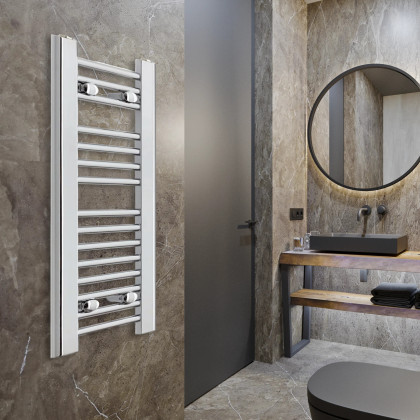
Available to order
£54.99Inc. VATRadiator only · valves extra
View sizes & options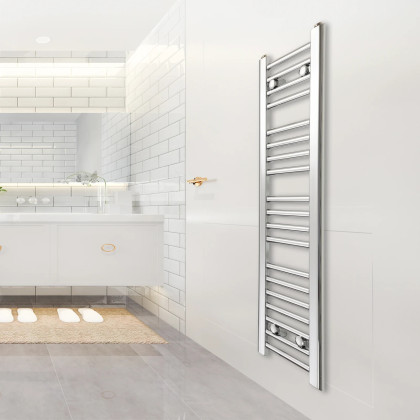
Available to order
£56.99Inc. VATRadiator only · valves extra
View sizes & optionsPrices and availability come from the current catalogue. Examples may differ in height and output. Check the exact model’s full specification, rating conditions and installation suitability before choosing.