
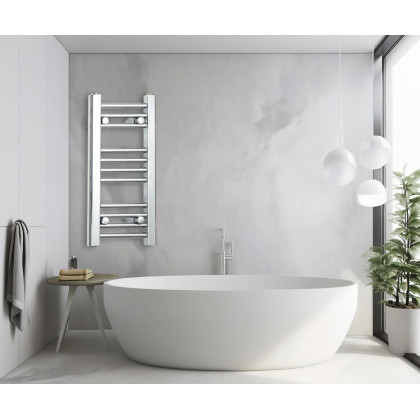
250mm Wide 600mm High Flat Chrome Towel Radiator
- Size
- 250 × 600mm (W × H)
- Pipe centres
- 200mm
- Finish
- Chrome
- Listed output
- 553 BTU/h · 162 W
Available to order
£44.99Inc. VATRadiator only · valves extra
View sizes & options
A 250mm towel radiator is a practical option when a 200mm body feels restrictive for hanging towels but a 300mm model would crowd the available wall. Its extra 50mm should be assessed alongside valve space, door movement and comfortable reach, because the nominal width describes only the radiator body.
Consider the narrow wall beside a vanity unit or the strip between a door architrave and a shower screen. Mark the finished rail and its fittings with removable tape, then try the room with the door open and a folded towel hanging in position.
Browse 250mm chrome towel radiators and 250mm matt black towel radiators; compare current heights, finishes and availability on the category pages. For fittings, see radiator valves and compatible accessories and pipe covers.
The linked 250mm chrome examples retain 200mm pipe centres across the heights below, allowing more vertical rail space where the wall cannot accommodate extra width. These are model-specific catalogue figures checked on 18 November 2026, so use the linked product and its rating conditions rather than treating height as a universal output formula.
Swipe or scroll sideways to see every column on a small screen.
| Height | Pipe centres | Listed output | Possible application | Finish choices |
|---|---|---|---|---|
| 600mm | 200mm | 553 BTU/h · 162W | Lower wall in a cloakroom | Chrome or matt black; compare the exact model |
| 800mm | 200mm | 745 BTU/h · 218W | Compact en-suite with useful reach | Chrome or matt black; compare the exact model |
| 1000mm | 200mm | 937 BTU/h · 275W | Wall beside a vanity unit | Chrome or matt black; compare the exact model |
| 1200mm | 200mm | 1,128 BTU/h · 330W | More vertical hanging positions | Chrome or matt black; compare the exact model |
| 1400mm | 200mm | 1,275 BTU/h · 374W | Taller wall; check top-rung access | Chrome or matt black; compare the exact model |
| 1600mm | 200mm | 1,420 BTU/h · 416W | High narrow wall; check reach | Chrome or matt black; compare the exact model |
| 1800mm | 200mm | 1,612 BTU/h · 473W | Tall installation with suitable access | Chrome or matt black; compare the exact model |
The 250 × 1200mm rating is 1,128 BTU/h (330W), confirmed by the business. Different tall listings can have different outputs or mounting dimensions even at the same nominal size; this table identifies particular models, while the product cards below show current prices and availability.
An application example is not a room-heating guarantee. A taller rail normally adds surface area and hanging opportunities within a comparable range, but only the actual rated output can establish whether it meets your calculated requirement.
A 250mm body width and 200mm bottom connection centres measure different parts of the radiator, while wall projection measures how far it extends into the room. The linked chrome examples use 75–95mm wall-to-pipe-centre distance and 90–110mm overall projection, including the 1600mm and 1800mm models confirmed by the business.
The business has confirmed that the 250mm-wide 1600mm and 1800mm models use the same mounting dimensions as the 1200mm model: 75–95mm wall to pipe centre and 90–110mm total projection. Check the selected bracket setting and finished wall before installation.
For side clearance, add the actual valve head and connection projections to the body width. Fittings adding 30–50mm on each side would produce a 310–350mm footprint; access to turn the controls and remove a component may require additional space. See the 250mm wall-space and valve-clearance guide.
The appropriate valve arrangement depends on the direction of the existing pipes and radiator connections, not simply whether the rail is described as narrow. Straight valves commonly suit aligned pipework rising from the floor, while angled or corner arrangements may suit wall-fed pipes when their drawings match the intended orientation.
A corner valve can place its control closer to the wall in some installations, helping avoid a door frame or walkway. It does not guarantee less projection than every angled valve; compare the exact head, union, pipe connection and access dimensions with our straight, angled and corner valve guidance.
For 8mm or 10mm microbore pipes, ask the installer which compatible reducers are required. Pipe covers and caps finish the visible pipework; they do not adapt an unsuitable valve or change the radiator’s connection centres. Browse valves and fittings, T-pieces and finishing accessories.
A 250mm towel rail can provide the room’s main heat only if the chosen model delivers enough output at the actual system temperatures to meet the design heat loss. Compare insulation, glazing and ventilation as well as room dimensions, and remember that towels over the bars can affect heat delivery to the room.
Use the BTU calculator to start the assessment, then ask the installer to confirm the design requirement. A narrow rail can also be used for towels alongside underfloor heating or a separate radiator where it cannot cover the whole room load.
Matt black coatings generally have higher radiant emissivity than polished chrome at the same surface temperature, but radiant heat is only part of the total output. Geometry, surface area, water temperature and convection also matter, so compare the declared ratings of complete models under matching conditions rather than applying a fixed finish percentage.
A radiator advertised with a verified ΔT50 rating will deliver less heat when the difference between its mean water temperature and room temperature is reduced. At ΔT30, an illustrative correction using an exponent of 1.3 gives roughly 51.5% of the ΔT50 output, but the manufacturer’s correction data should determine the final selection.
ΔT describes a temperature difference; it is not the boiler flow setting alone. For illustration, a verified 553 BTU/h ΔT50 rating would become about 285 BTU/h, or 84W, under that ΔT30 assumption; this calculation does not independently verify the listed rail’s rating basis.
Check the selected model’s original test conditions before using the calculation. Follow the narrow-radiator heating guide and ΔT50 and ΔT30 explanation if lower-temperature heating is part of the plan.
The nominal 250mm width includes the upright tubes, so the usable hanging span is smaller and should be checked with your own folded towels. A hand towel may fit neatly, while a bath towel or bath sheet usually needs folding or hanging vertically over suitable rungs rather than being spread flat.
Fold a dry towel to the proposed width and check its drop against the valves and floor. Leave room for air around it, and choose a height that children or other household members can reach comfortably; the highest bar adds little everyday convenience if nobody can use it.
Compared with a 200mm body, another 50mm may make the folded towel easier to handle without turning the rail into a full-width drying rack. Compare 200mm and 250mm rails or browse 300mm chrome options when the finished wall has more space.
Wall support must be chosen for the water-filled radiator, its fittings and the towels it will carry, with the bracket arrangement specified for the exact product. On plasterboard or stud walls, an installer should assess the structure, suitable studs or timber noggins and any approved cavity-fixing arrangement before selecting anchors or drilling.
Ordinary supplied masonry plugs are not automatically suitable for plasterboard. Do not use the towel rail as a grab rail or hang body weight from it; also check concealed pipework and cables before making any holes.
The supplied fittings include full wall brackets, an air vent and a blanking plug for the linked examples. Confirm the complete contents on the chosen product page and use the plasterboard and stud-wall fixing guide to prepare the installation questions.
A central-heating 250mm rail is not automatically approved for electric-only or dual-fuel use because its bottom connection accepts a ½-inch BSP fitting. The exact radiator and element must be a compatible combination with the correct power, insertion length, filling method and expansion provision agreed by the supplier and responsible installers.
There is no universal 100–150W element recommendation for this width. A dual-fuel T-piece provides a connection arrangement rather than proof of compatibility, and safe valve operation depends on the approved system design; follow the dual-fuel conversion checklist rather than improvising a sealed arrangement.
A registered electrician must assess bathroom locations against BS 7671 and the manufacturer’s instructions. Zones 1 and 2 generally require at least IPX4 protection, with IPX5 where water jets are expected, but an IP rating alone does not approve a product, fused-spur arrangement or installation position.
Outside the bath or shower zones still requires assessment of the complete equipment and bathroom conditions. A basin alone does not create a universal numbered zone; Part P and notification duties depend on the work and UK jurisdiction, so use the bathroom electrical installation-planning guide and a suitably registered professional.
Before ordering, record the finished wall space, the selected radiator’s connection and bracket dimensions, and the full valve footprint rather than relying on the width label alone. Check heat loss, towel reach, safe wall support and any electrical requirements with the installer, then confirm current availability and the chosen options on the live product page.
The radiator warranty is 5 years; valves and heating elements have a 1-year warranty, subject to the applicable terms. Cheap Radiator offers warehouse support and collection from Unit 6, Hales Industrial Park, Coventry, CV6 6AT; confirm collection availability with the team before travelling.
These six supporting guides separate the main measuring, heat-output and installation choices so you can investigate the questions that matter to your own bathroom. The clearance article is specific to the 250mm range, while the shared comparison, heating, conversion, fixing and finish guides connect those decisions back to the complete buying checklist.
Browse 250mm chrome towel radiators and 250mm matt black towel radiators; compare current heights, finishes and availability on the category pages. For fittings, see radiator valves and compatible accessories and pipe covers.
The 250mm-wide ladder towel radiators in this range have 200mm centres between their bottom connections, measured from the centre of one tapping to the other. Existing pipework must also suit the selected valves, so a 200mm pipe measurement alone does not confirm a complete replacement will fit without alterations.
Allow for the 250mm body plus the actual side projection of both valves, operating clearance and any nearby obstruction before choosing the position. A 310–350mm footprint is an example when fittings add 30–50mm per side, not a universal requirement; check the selected valve drawing and test the door swing.
A 250mm towel radiator can be the main bathroom heater when its rated output at the intended water temperatures meets the room’s calculated heat loss. Room size alone is insufficient: insulation, glazing, ventilation, towel coverage and the chosen height all influence whether another heat source is required for comfortable use.
A 250mm rail can be mounted on a suitable plasterboard or stud wall when the supporting structure and fixings are designed for the complete installed load. Ask the installer to assess the water-filled weight, towel load, bracket positions and access to studs or timber noggins before specifying anchors or drilling.
A conversion is possible only where the exact radiator, element and fittings form a manufacturer-approved combination with suitable filling and expansion arrangements. Matching a ½-inch BSP thread does not establish the correct wattage or insertion length; ask the supplier and installer to confirm those details before ordering an element or T-piece.
A registered electrician must assess the proposed position against the bath or shower zones, manufacturer instructions and the applicable BS 7671 requirements before selecting equipment. An IPX4 or IPX5 marking alone does not approve the complete installation, and being outside the zones does not remove the need for a location-specific assessment.
Choose the width that leaves enough room for the whole installation and everyday access, then compare the exact model’s output and usable towel space. Moving from 200mm to 250mm adds 50mm of body width and changes centres from 150mm to 200mm; a 300mm body in these ranges uses 250mm centres.
Huseyin Aras is a bathroom heating and product sourcing specialist with more than 18 years of hands-on experience helping customers and installers assess towel radiators and their fittings. This guide combines Cheap Radiator’s current catalogue details with practical measuring questions and the technical sources below, without replacing the selected manufacturer’s installation instructions.
The linked product descriptions were checked on 18 November 2026, and the business confirmed the factory test, temperature limit, warranty and author experience used in this guide. Manufacturer drawings, permitted working conditions and electrical instructions remain necessary for the exact combination selected, while the sources below explain the wider technical context.
Compare live 250mm-wide chrome examples in 600, 800 and 1000mm heights. Check the current options, exact output and full installation requirements before ordering.
Available to order
£44.99Inc. VATRadiator only · valves extra
View sizes & options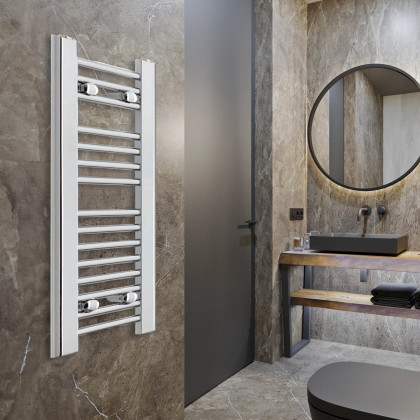
Available to order
£59.99Inc. VATRadiator only · valves extra
View sizes & options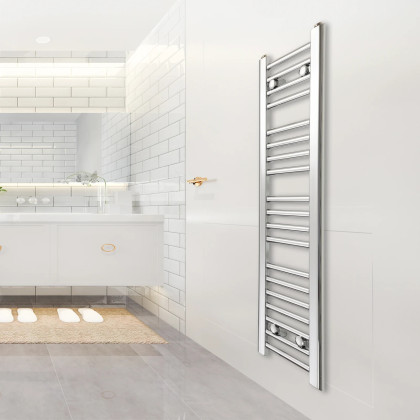
Available to order
£69.99Inc. VATRadiator only · valves extra
View sizes & optionsPrices and availability come from the current catalogue. Examples may differ in height and output. Check the exact model’s full specification, rating conditions and installation suitability before choosing.