
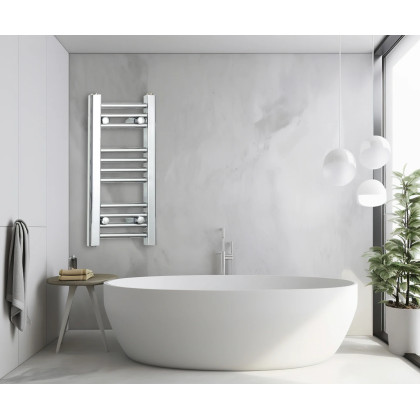
300mm Wide 600mm High Flat Chrome Towel Radiator
- Size
- 300 × 600mm (W × H)
- Pipe centres
- 250mm
- Finish
- Chrome
- Listed output
- 626 BTU/h · 185 W
Available to order
£53.99Inc. VATRadiator only · valves extra
View sizes & options
Quick answer: a 300mm body needs extra space for the valves, controls and folded towel. Its bottom radiator connections are 250mm apart; measure the complete fitted arrangement before assuming that a 300mm wall gap is usable.
Part of the 300mm towel radiator size and buying guide.
Allow the 300mm body width plus the selected valves and enough space to operate and maintain them without striking nearby furniture or a door frame. Two fittings projecting 30–50mm beyond the sides create an illustrative 360–400mm envelope, but that example must be replaced with the actual installed dimensions of your chosen valves.
Measure the finished surface after tiling and boxing, including any architrave or vanity overhang. Put marks on the wall for the radiator outline and for the furthest point of both valve heads, then test the position with the bathroom in normal use.
Compare the current 300mm chrome towel radiators and 300mm matt black towel radiators. For the complete fitted arrangement, browse radiator valves and pipe covers, reducers and other accessories.
The 250mm dimension is the centre-to-centre spacing between the bottom radiator connections on the linked 300mm models, rather than the width of the rail or the distance across complete valves. Existing pipe routes need a separate measurement because unions, elbows and valve orientation can introduce offsets even when the radiator tappings appear to line up.
Measure level between the connection centres and note how far the pipes stand from the finished wall. Take a photograph for the installer, but do not assume a photograph provides the accurate dimensions needed to order a replacement.
The neighbouring 250mm and 350mm body widths use 200mm and 300mm connection centres respectively. See the 300mm-versus-350mm width comparison before planning to reuse existing pipes.
The best arrangement is the one that matches the pipe direction while keeping its head, union and operating clearance away from nearby obstructions in the final fitted orientation. A corner valve may tuck a control closer to the wall than a particular angled alternative, but there is no universal space saving across every valve design.
For a worked example, a 300mm body with two 40mm side projections takes 380mm before service access. If one control extends farther, calculate each side separately; do not force the rail off centre just to hide an unsuitable fitting behind furniture.
Review straight, angled and corner radiator valves and ask about compatible 8mm or 10mm microbore reducers where needed. Keep enough access to remove a cap or turn a control without dismantling the neighbouring vanity.
The linked 400–1400mm chrome examples list 75–95mm from wall to pipe centre and 90–110mm overall projection, before adding any towel or valve projection beyond that outline. Tall models can differ, with older 1600mm and linked 1800–2000mm examples listing 70–85mm and 85–100mm, so carry the selected model’s drawing into the fitting plan.
The current 26-tube 1600mm chrome model lists the larger 75–95mm and 90–110mm dimensions. This difference is a reason to use the product reference, rather than a height label alone, when discussing replacement brackets or existing pipework.
Try a side-view card template at the maximum intended projection, then add the towel. The accessible dimension diagram in the 300mm radiator body and connection guide separates width, connection centres and wall projection.
A position that works with the door shut and the radiator empty may become unusable when a bath towel hangs down or a drawer is opened. Include skirting thickness, door handles, shower-screen movement and the towel’s folded drop, checking that household members can pass and reach the controls comfortably without touching hot pipework.
Open every nearby fitting through its normal travel with a temporary wall template in position. Check the bottom valves as carefully as the bars; skirting and pipe boxing often reduce the lower space even where the wall above appears clear.
If clearance is too tight, compare a narrower body before moving the pipes. Extra height can sometimes recover surface area, but use the heat-output and room-sizing guide to establish whether that alternative provides enough heat.
Finding a clear strip of wall does not establish that its structure can safely support the filled radiator, valves and towels at the specified bracket points. On plasterboard or stud walls, the installer should check studs, timber noggins or a suitable approved cavity-fixing design and locate concealed pipes and cables before choosing anchors or drilling.
Do not shift brackets outside the manufacturer’s permitted arrangement to meet a stud or clear an obstacle. Supplied masonry plugs are not a general approval for plasterboard, and the towel rail must not be used as a support handle.
Follow the plasterboard and stud-wall fixing guide for the preparation questions, then confirm the actual fixings with the responsible installer.
Record the exact product reference, finished opening, radiator centres, bracket range and valve projections together so the supplier and installer assess the same installation envelope. Add heat-loss and towel-reach checks before selecting the height, and confirm the current options and availability instead of assuming that every listed finish and size is immediately available.
Return to the complete 300mm towel radiator buying guide for the height table, warranty and electrical compatibility checks, or compare 300mm and 350mm widths.
Compare live 300mm chrome examples in 600, 800 and 1000mm heights. Confirm the current price, valve options, heat output and installation requirements on each product page.
Available to order
£53.99Inc. VATRadiator only · valves extra
View sizes & options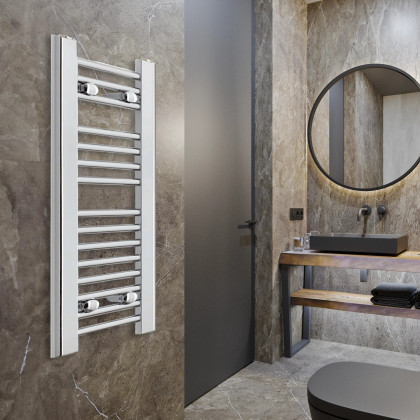
Available to order
£61.99Inc. VATRadiator only · valves extra
View sizes & options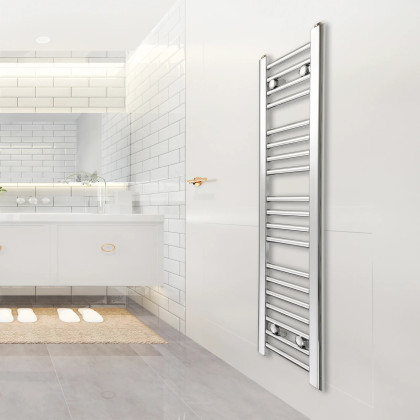
Available to order
£77.99Inc. VATRadiator only · valves extra
View sizes & optionsPrices and availability come from the current catalogue. Examples may differ in height and output. Check the exact model’s full specification, rating conditions and installation suitability before choosing.